Let Them Roam: Why Kids Need Unsupervised Play More Than Ever
- Post author:mycrumbyworld
- Post published:May 6, 2026
- Post category:Parent Pantry
- Post comments:0 Comments
There’s a quiet shift happening in childhood, and not in a good way.
Kids today are safer than ever on paper… yet more anxious, less confident, and increasingly disconnected from the real world. As parents, we’ve been taught that constant supervision equals good parenting. But what if that belief is actually standing in the way of raising strong, capable, resilient kids?
This is the tension many of us are starting to feel——>and it’s one worth paying attention to.
📱 From Play-Based to Phone-Based Childhood
In The Anxious Generation, social psychologist Jonathan Haidt outlines a powerful shift: children have traded a play-based childhood for a phone-based one.
Instead of climbing trees, knocking on neighbors’ doors, or figuring out how to settle a disagreement on their own, many kids are:
- Indoors
- On screens
- Under constant adult supervision
While it may feel safer, this kind of childhood is missing something critical: real-world experience.
Kids aren’t getting enough opportunities to:
- Take risks
- Solve problems independently
- Navigate social dynamics without adult intervention
- Build confidence through trial and error
And without those experiences, something important doesn’t develop…resilience.
🇩🇰 What Denmark Is Doing Differently
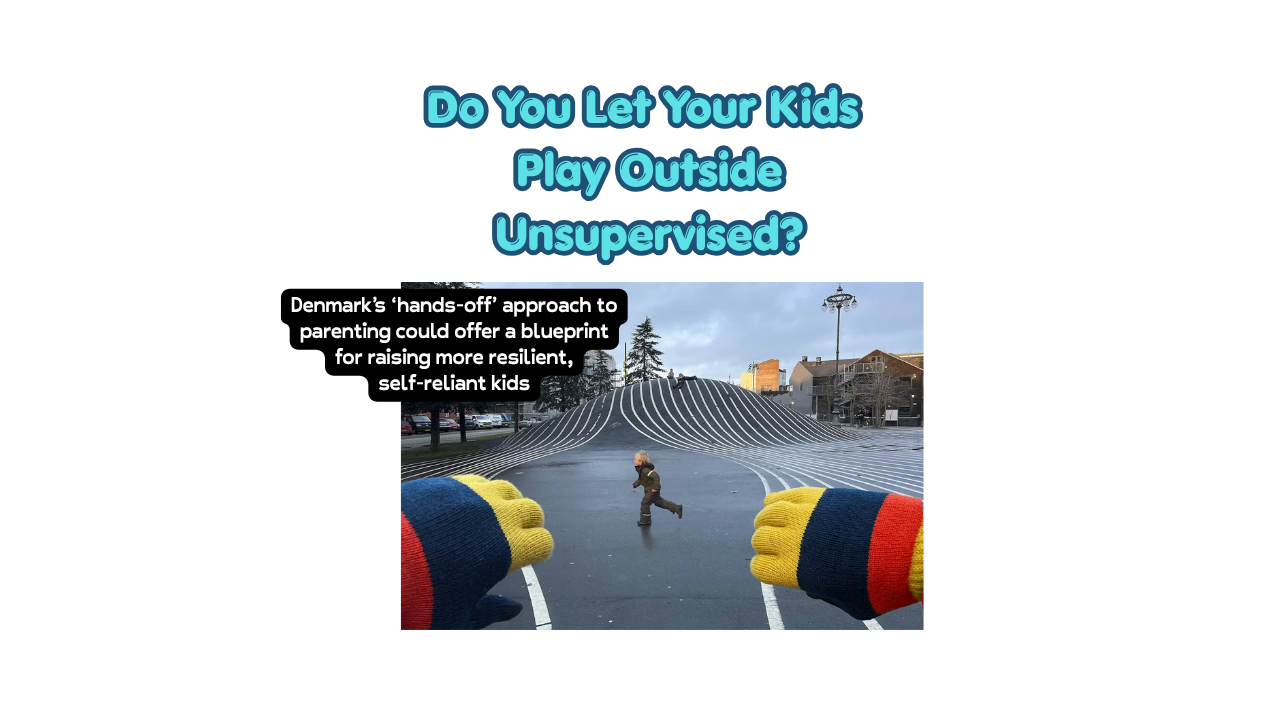
A recent article from The Conversation highlights how Denmark is taking a very different approach to raising children.
In Danish culture, children are often given far more freedom at a younger age. This includes:
- Walking or biking to school alone
- Playing outside unsupervised
- Engaging in what many American parents would consider “risky” play (climbing, exploring, experimenting)
And here’s the surprising part: it’s working.
Researchers are finding that these children tend to be:
- More self-reliant
- More emotionally regulated
- More confident in unfamiliar situations
- Better problem-solvers
Rather than shielding kids from every possible risk, Danish parenting leans into the idea that manageable risk builds capability.
⚠️ The Hidden Cost of Overprotection
As parents, our instinct is to protect. That’s natural—and necessary.
But when protection becomes overprotection, kids can begin to internalize a subtle but powerful message:
“The world is dangerous… and you’re not capable of handling it without me.”
Over time, this can lead to:
- Increased anxiety
- Fear of failure
- Lack of independence
- Difficulty making decisions
Ironically, in trying to keep our kids safe, we may be making them less equipped to handle life safely on their own.
🌳 Why Unsupervised Play Matters
Unsupervised outdoor play isn’t just about “letting kids be kids.” It’s about giving them access to the kinds of experiences that build lifelong skills.
When kids play freely, they learn to:
- Assess risk (“Is this branch strong enough to climb?”)
- Resolve conflict (“We both want the same swing—what do we do?”)
- Problem-solve (“How do we build this fort so it doesn’t fall?”)
- Self-regulate (“That was scary… but I handled it.”)
These are not skills that can be taught through lectures or apps.
They are lived experiences.
💛 A New Way to Think About “Good Parenting”
What if good parenting isn’t about being everywhere… but about knowing when to step back?
What if the goal isn’t to eliminate all risk—but to teach kids how to navigate it?
Letting your child play outside unsupervised doesn’t mean being careless. It means being intentional about gradually giving them more independence in a way that matches their age, maturity, and environment.
🌱 How to Start (Without Feeling Terrified)
If this idea makes you a little uncomfortable—you’re not alone. Most of us were raised in a culture that equates supervision with safety.
Here are a few simple ways to begin:
1. Start Small
Let your child play in the yard or a nearby area while you stay inside but accessible.
2. Set Clear Boundaries
Define where they can go, who they can be with, and when they need to check in.
3. Build Confidence Gradually
Give them small responsibilities—walking a short distance, running an errand, or playing at a neighbor’s house.
4. Find Like-Minded Parents
There’s strength in community. When multiple families share similar values, it creates a safer, more supportive environment for kids to explore.
5. Trust the Process
It might feel uncomfortable at first—but growth often does.
✨ The Bigger Picture
We are raising the next generation in a world that desperately needs people who can:
- Think independently
- Adapt to challenges
- Build meaningful relationships
- Trust themselves
These qualities don’t come from perfectly curated, fully supervised childhoods.
They come from scraped knees, solved problems, small risks, and moments where no adult stepped in.
They come from freedom.