
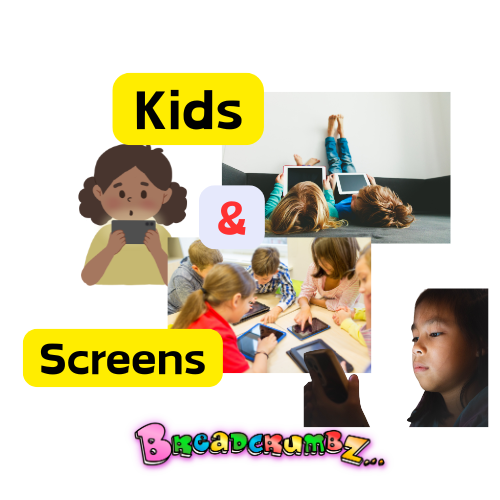
Is Too Much Screen Time Stealing Your Child’s Social Skills?
- Post author:mycrumbyworld
- Post published:June 12, 2026
- Post category:Parent Pantry
- Post comments:0 Comments
As parents, many of us have found ourselves in the same situation.
You’re trying to make dinner, answer emails, fold laundry, or simply enjoy a few quiet moments. Handing your child a tablet or turning on a favorite show seems harmless enough. After all, screens can be educational, entertaining, and convenient.
But deep down, many parents are beginning to ask a difficult question:
What is all this screen time replacing?
For years, the conversation around screen time focused on attention spans, sleep, and academic performance. Today, a growing number of parents are worried about something else entirely…the impact screens may be having on their children’s social development.
The Skills Children Can’t Learn From a Screen
Learning how to read, count, and identify colors is important. But when children enter preschool or kindergarten, teachers consistently report that some of the most important skills for success aren’t academic at all.
Children need to learn how to:
Take turns
Share with others
Follow directions
Resolve simple conflicts
Listen when someone else is speaking
Handle disappointment
Ask for help appropriately
Work as part of a group
Show empathy and kindness
These skills are developed through real-life experiences with other people.
When children spend more time interacting with screens than with family members, friends, neighbors, and classmates, they miss valuable opportunities to practice these behaviors.
The Hidden Cost of Convenience
Let’s be honest. Screens aren’t the enemy.
Most parents aren’t handing their children devices because they don’t care. They’re doing it because life is busy.
The problem isn’t occasional screen use. The problem occurs when screens begin replacing experiences that help children develop confidence, curiosity, cooperation, and compassion.
Think about it.
A child watching someone bake cookies on a screen is entertained.
A child baking cookies alongside a parent is learning patience, communication, teamwork, problem-solving, and responsibility.
One is consumption.
The other is growth.
Why Social Skills Matter More Than Ever
Many teachers have reported seeing children enter school with fewer opportunities to practice social interaction than previous generations.
Some children struggle to:
- Join a group activity
- Start conversations
- Work through disagreements
- Persist through challenges
- Manage frustration
These skills don’t magically appear when a child starts kindergarten.
They are developed over time through play, conversation, exploration, and everyday experiences.
The good news is that social skills can be learned.
And parents are uniquely positioned to help.
Small Changes Can Make a Big Difference
Building social and emotional skills doesn’t require expensive programs or elaborate schedules.
Simple activities can have a tremendous impact:
Reading stories together
Baking in the kitchen
Playing board games
Exploring nature
Completing simple projects as a family
Having conversations at dinner
Encouraging imaginative play
Visiting parks and playgrounds
Giving children opportunities to solve age-appropriate problems
Every one of these activities teaches children something screens cannot.
Raising Children Who Can Thrive
At The Breadcrumbz, we believe children need more than academic preparation. They need life preparation.
That’s why our characters focus on the qualities that help children succeed both in school and beyond:
Penelope Pumpernickel teaches Courage.
Rachel Rye teaches Cooperation.
Samantha Sourdough teaches Confidence.
Whitney Wheat teaches Compassion.
PJ Pumpernickel teaches Curiosity.
These aren’t just nice character traits. They are the foundation of healthy friendships, strong communication skills, and lifelong learning.
A Challenge for Parents
This week, try replacing just thirty minutes of screen time with a hands-on activity.
Bake something together.
Read a story.
Take a walk.
Play a game.
Ask questions.
Listen to your child’s ideas.
You may be surprised by what happens.
Because while screens can entertain children, relationships help them grow.
And the social skills children develop today will help shape the confident, capable adults they become tomorrow.


